 Bookkeeping Perth | Bookkeeping Services Perth | Bookkeepers PerthBookkeeping Perth | Bookkeeping Services Perth | Bookkeepers Perth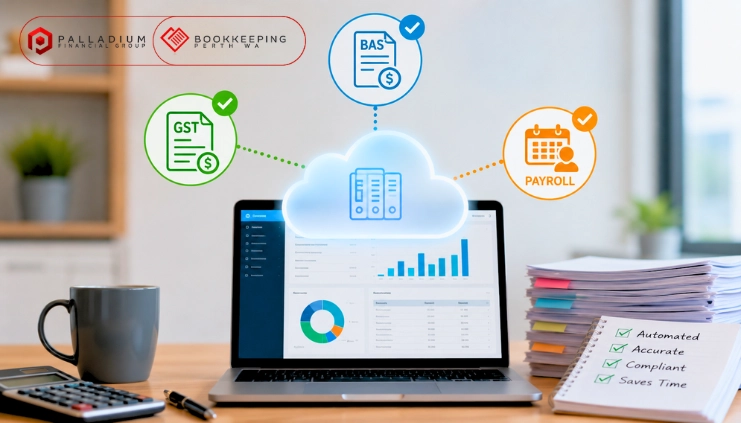
If you are running a business in Perth, you already know the feeling. The end of each quarter rolls around, and suddenly, you are scrambling to pull together invoices, payslips, bank statements, and receipts to lodge your Business Activity Statement on time. Miss the deadline, and the Australian Taxation Office is not forgiving.
The good news? Cloud bookkeeping has quietly taken over this entire headache – and most Perth business owners do not even realise how much of their compliance work is now being handled automatically in the background.
In this article, we are going to break down exactly how cloud bookkeeping manages your GST, BAS, and payroll obligations – in plain language, with no accounting jargon.
Before we get into the specifics, let us quickly set the scene.
Cloud bookkeeping simply means your financial records are stored and managed online – through software like Xero or MYOB – rather than on a desktop program or paper ledger. You can access everything from your phone, laptop, or tablet, anytime you need it.
But the real game-changer is not convenience. It is automation.
Modern cloud bookkeeping platforms are built to talk directly to the ATO. They track your GST in real time, prepare your BAS figures automatically, and report your payroll data to the government every single pay run. By the time your lodgement deadline arrives, most of the work is already done.
Here is how each of the three big compliance areas works.
If your Perth business earns over $75,000 per year, you are required to register for GST and charge your customers an additional 10% on most goods and services. You then need to report how much GST you collected versus how much GST you paid on business purchases – and pay the difference (or claim a refund) to the ATO.
Simple in theory. In practice, keeping track of every taxable and GST-free transaction manually across hundreds of invoices each quarter is where most businesses come unstuck.
With a cloud bookkeeping platform like Xero or MYOB, every transaction is automatically categorised and GST-coded as it enters the system – whether it comes in via a bank feed, a digital invoice, or a payment gateway.
By the time your BAS is due, your GST figures are already sitting in the system – calculated, verified, and ready to review.
A Business Activity Statement (BAS) is the form you lodge with the ATO – typically every quarter – to report your:
Most businesses with a GST turnover of $75,000 or more must lodge a BAS quarterly. Miss a lodgement, and the ATO can charge a failure-to-lodge penalty – currently $330 per penalty unit, and it compounds.
This is where cloud bookkeeping really earns its place.
Because your GST and PAYG withholding are tracked continuously throughout the quarter, your BAS figures are essentially pre-built by the time lodgement day arrives. Your cloud bookkeeper reviews the numbers, checks everything reconciles correctly against your bank statements, and lodges on your behalf through the ATO portal – all without you needing to dig out a single receipt.
Here is what happens in a well-managed cloud bookkeeping system each quarter:
At Bookkeeping Perth Wide, our cloud bookkeepers handle this entire process for you using Xero and MYOB. You get a completed BAS lodgement every quarter, along with a clear summary of what you owe (or are owed) – so there are no surprises.
Single Touch Payroll is an Australian government requirement that automates payroll reporting to the ATO. Every time you pay your staff – whether that is weekly, fortnightly, or monthly – your payroll software sends a report to the ATO containing:
STP Phase 2 expanded this further, requiring businesses to break down pay into more detailed categories – separating overtime, allowances, bonuses, and leave payments, rather than reporting a single gross figure. This is now mandatory for all Australian employers.
If you are still processing payroll manually or using software that does not support STP Phase 2, you are already at compliance risk.
Xero and MYOB are both fully STP Phase 2 compliant. When you process a pay run through either platform, the software automatically:
At the end of the financial year, the same system handles STP finalisation – the formal declaration that all wages and withholding figures for the year are correct. This is due by 14 July each year, and it pre-fills your employees’ tax returns automatically.
If you have employees, this is critical: from 1 July 2026, Australia is moving to Payday Superannuation. Instead of paying superannuation quarterly, employers will need to pay superannuation at the same time as wages – every single pay run.
This is the biggest superannuation reform in decades, and businesses that are not set up on cloud payroll software are going to struggle. Manually calculating and paying super every fortnight is an enormous administrative burden. Cloud bookkeeping platforms like Xero handle this automatically – super is calculated, scheduled, and paid in line with your payroll cycle.
Let us be honest – compliance is not why most Perth business owners started their company. You started to build something, serve your customers, and grow. Managing GST codes, BAS deadlines, and STP lodgements is not what you signed up for.
Cloud bookkeeping with a professional team behind it means:
And most importantly, you get your time back.
Not all cloud bookkeeping services are equal. When choosing a provider in Perth, look for:
At Bookkeeping Services Perth Wide, our team ticks every one of these boxes. We work with Perth businesses across a range of industries – from trades and retail to professional services and hospitality – delivering cloud bookkeeping services that keep you compliant and in control.