Bookkeeping Perth | Bookkeeping Services Perth | Bookkeepers PerthBookkeeping Perth | Bookkeeping Services Perth | Bookkeepers Perth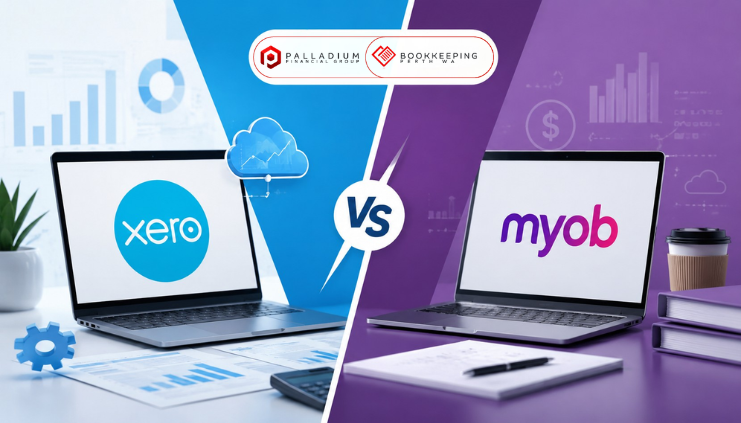
If you’re running a small business in Perth and trying to decide between Xero and MYOB, you’re not alone. These two platforms dominate cloud accounting in Australia, and picking the wrong one can cost you hours of admin time and hundreds of dollars a year in features you don’t actually need.
At Bookkeeping Perth, we work hands-on with both platforms every day through our Xero Bookkeeping Perth and MYOB Bookkeeping Services, so this comparison isn’t theoretical – it’s based on what actually works for real Perth small businesses lodging real BAS statements and running real payroll.
Here’s the honest, no-fluff breakdown of Xero vs MYOB for 2026, so you can choose with confidence.
| Feature | Xero | MYOB |
| Best for | Startups, service businesses, businesses wanting simplicity | Businesses with complex payroll or inventory needs |
| Ease of use | Very intuitive, minimal accounting knowledge needed | Slightly steeper learning curve, more traditional |
| Starting price | From approx. $35/month | From approx. $30-33/month |
| App integrations | 1,000+ third-party apps | Fewer integrations, but strong Australian-specific tools |
| Payroll | Included from mid-tier plans up | Strong payroll for complex award structures |
| Inventory management | Basic, extendable via apps | More advanced, built-in |
| BAS & GST lodgement | Direct ATO lodgement | Direct ATO lodgement |
| Support | Email/chat, 24/7 online help | Phone support on higher plans |
| STP Phase 2 compliant | Yes | Yes |
(Pricing and plan inclusions change regularly – always confirm current rates directly with Xero or MYOB, or ask your bookkeeper to check the latest plan comparison for you.)
Xero was built cloud-first from day one, and it shows. The dashboard is clean, invoicing takes minutes, and most business owners can navigate it without formal training. This is a big reason why Xero has become the go-to for cloud bookkeeping in Perth, especially among trades, hospitality, and service-based businesses that want to check their numbers on the go.
MYOB has modernised significantly, but it still carries some of its legacy, more traditional accounting terminology. It’s not difficult – but it typically suits businesses that already work alongside a bookkeeper who’s comfortable with the platform.
Verdict: Xero wins on ease of use for owner-operators managing their own books day to day.
Both platforms use tiered subscription pricing, and at face value they’re closely matched. The real cost difference shows up once you add payroll, multiple users, or inventory tracking – features that push you into higher tiers on both platforms. MYOB’s entry plans can be slightly cheaper for very simple sole traders, while Xero tends to offer better value once your business needs more than 2-5 employees on payroll.
Verdict: Roughly even – the right choice depends on your transaction volume and whether you need payroll from day one.
Both Xero and MYOB are fully STP Phase 2 compliant, meaning both can handle Single Touch Payroll reporting directly to the ATO. Where MYOB pulls ahead is in businesses with more complex award interpretation – multiple pay rates, allowances, and larger teams. Xero’s payroll is excellent for straightforward setups but can require more manual configuration for complicated award structures common in hospitality and construction.
Verdict: MYOB has a slight edge for complex payroll; Xero is simpler for straightforward teams.
This is where a good bookkeeper matters more than the software itself. Both platforms let you lodge your BAS directly with the ATO and generate GST reports automatically from reconciled transactions. The real risk isn’t the software – it’s incorrect GST coding, which is one of the most common reasons Perth businesses face BAS penalties or amended lodgements. Whichever platform you use, accurate reconciliation is what actually protects you at tax time.
Verdict: Tied – both are ATO-compliant; accuracy comes down to how well the books are reconciled.
If you sell physical stock, MYOB’s built-in inventory tools (multi-location tracking, stocktake, purchase orders) are more comprehensive out of the box. Xero’s native inventory features are more basic, though they can be extended significantly with add-on apps like Cin7 or Unleashed.
Verdict: MYOB wins for inventory-heavy businesses; Xero wins if you’re happy adding a specialised app.
Xero connects with over 1,000 third-party apps – everything from Shopify and Stripe to job management tools like ServiceM8 and Deputy. MYOB’s ecosystem is smaller but covers the core Australian-specific tools well. If your business relies on several connected apps (POS, CRM, time tracking), Xero’s ecosystem gives you more flexibility.
Verdict: Xero wins for businesses running multiple connected tools.
That’s exactly where working with a local bookkeeper pays off. Our team provides dedicated Xero Bookkeeping Perth services for businesses that want a clean, automated cloud setup, and specialist MYOB Bookkeeping Services for businesses with more complex payroll or inventory needs – so whichever platform you land on, your books stay accurate and audit-ready.
Q.1 Is Xero or MYOB better for a small business just starting out?
A. Xero is generally easier for new business owners with no accounting background, thanks to its intuitive interface and simpler setup process.
Q.2 Can I switch from MYOB to Xero without losing my data?
A. Yes, both platforms support data migration, though it should be planned carefully with a bookkeeper to make sure historical records, GST codes, and payroll history transfer correctly.
Q.3 Which is cheaper, Xero or MYOB?
A. Pricing is closely matched at entry level. The cost difference usually appears once you add payroll for multiple employees or inventory management, so it’s worth comparing plans based on your specific business needs rather than the base price alone.
Q.4 Do I still need a bookkeeper if I use Xero or MYOB?
A. Yes. Both platforms automate data entry and reporting, but accurate GST coding, reconciliation, and BAS lodgement still require a qualified bookkeeper or BAS agent to avoid costly errors and ATO penalties.
Q.5 Which software do most Perth bookkeepers recommend?
A. It depends on your business type. Many Perth bookkeepers recommend Xero for service-based and trades businesses, and MYOB for businesses with heavier payroll or inventory requirements. A quick consultation can help match the platform to your actual workflow.